
Facing Aggressive Suppression
Revealing Evidence of Suppression on Multiple Platforms

Let me say right off the bat that I make this post rather reluctantly. I generally don’t want to focus on the negative, and would very much prefer to continue to create in a positive manner. And this is exactly what I have been doing up to this point; some of the most blatant and compelling evidence of suppression, which I will soon discuss, has been tucked away by me for well over a year now. However, recent developments have made it too difficult to ignore what is a debilitating and continuing phenomenon. In addition, I feel that it is almost always a positive thing to shed light on a subject, no matter how negative that subject happens to be. I also feel that by revealing this information, I can make it backfire on its perpetrators by helping to inform and ultimately popularize my work. In other words, I want to alchemize their negativity into positivity.
Case in Point: YouTube
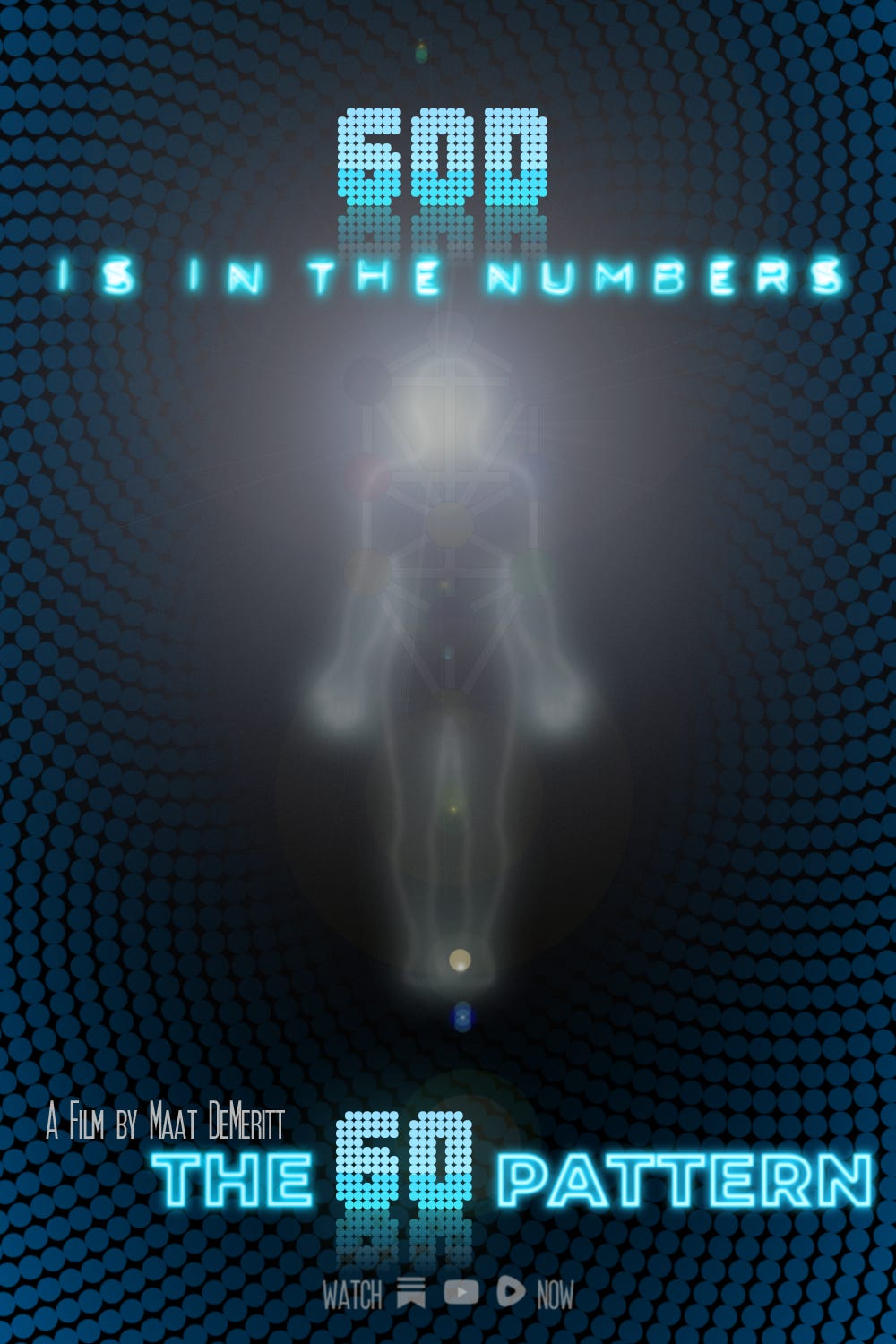
In February of 2024, I published an hour-long documentary called The 60 Pattern on various platforms, including here on Substack. I also published it on YouTube, which, with over a hundred million active users per day and billions of active users monthly, is by far the most popular video platform in the world. For many people, it is also the most rewarding video platform in the world, but certainly not for me.
YouTube:
does not recommend my video (as in the common practice of recommending similar videos to a user),
withholds my video from search results (unless the exact title is typed in), and
freezes my view count during times of heavy traffic.
We are going to look at direct evidence for that last point momentarily, but not before we consider some highly indicative yet indirect evidence for the first point (and later, direct evidence for this point will also be brought in). As for the middle point, I can only cite anecdotal evidence by myself and some close friends and family members, as well as to ask you to test some searches for yourself. Following our consideration of the evidence, we will look at the potential motive for the suppression, which probably has little to do with the The 60 Pattern documentary itself. That’s important to keep in mind as we move forward.
If you look on YouTube for documentary videos covering such topics as ancient mysteries, Sumeria and the Anunnaki, the Fibonacci series and the golden ratio, theories of human consciousness, spirituality, and the origin of the universe, Sacred Geometry, the role of sound and music, and so on, all of which are covered in varying detail The 60 Pattern, you will find many hundreds of videos with view counts in the hundreds of thousands—if not millions. I find that this video, called Sonic Geometry, is quite similar in several respects to The 60 Pattern. It currently has 2.9 million views, and it’s a good guess that a majority of those views came within the first few years after the documentary was published, which was about eleven years ago. But even if we divide the total views evenly among its eleven years, that’s still about 264,000 views per year. Compared to that, my meager 780 views after about a year and a half seems like a cruel joke. I will add that The 60 Pattern is much more factually based, academically rigorous, and has much more profound significance and startling revelations than Sonic Geometry, at least in my opinion. I would, of course, encourage you to see for yourself though.
In conjunction with publishing my documentary, I launched a social media marketing campaign on multiple fronts. This included creating a dedicated Facebook page for The 60 Pattern, the activities and data from which—hereby to be examined—will lead to a startling, nearly inescapable conclusion.
In late March of 2024, about a month and a half after publishing The 60 Pattern, I broke through the social media blockade with a couple of posts made to a group called Sacred Geometry, which had over 1 million members at the time (it currently sits at about 1.4 million members). I say “blockade” because posting to social media groups is a constant struggle against gatekeepers, who will “decline” posts (Facebook’s terminology; read: censor) even though they are clearly relevant to the group and comply with all group rules. Actually, it’s unclear in any given case whether one is dealing with an actual person taking the role of a gatekeeper/censor, or whether it is Facebook’s AI Admin Assist feature—used by many group administrators now—that is largely to blame. That feature, much like Facebook’s algorithms that control who sees your post if it passes the blockade (and that’s a big “if” if you’re actively being shadowbanned), is largely a black box.
The two breakthrough posts ultimately had over 700 combined positive reactions, most of which occurred in the first few days after the posts went live. For the first post, that was on March 20th. Shortly thereafter, the page tracked a significant spike in both reach and engagement that peaked between March 22nd and March 25th. Reach is defined by Facebook as the estimated number of people who viewed your page’s content, while engagement tracks the number of reactions, comments, shares, and clicks (such as clicking “See more”) on your posts. As seen below, the 90-day total for reach and engagement—all occurring in the late-March window—was 65,503 and 3,237 people, respectively (the page itself was launched on Feb. 7th, 2024).
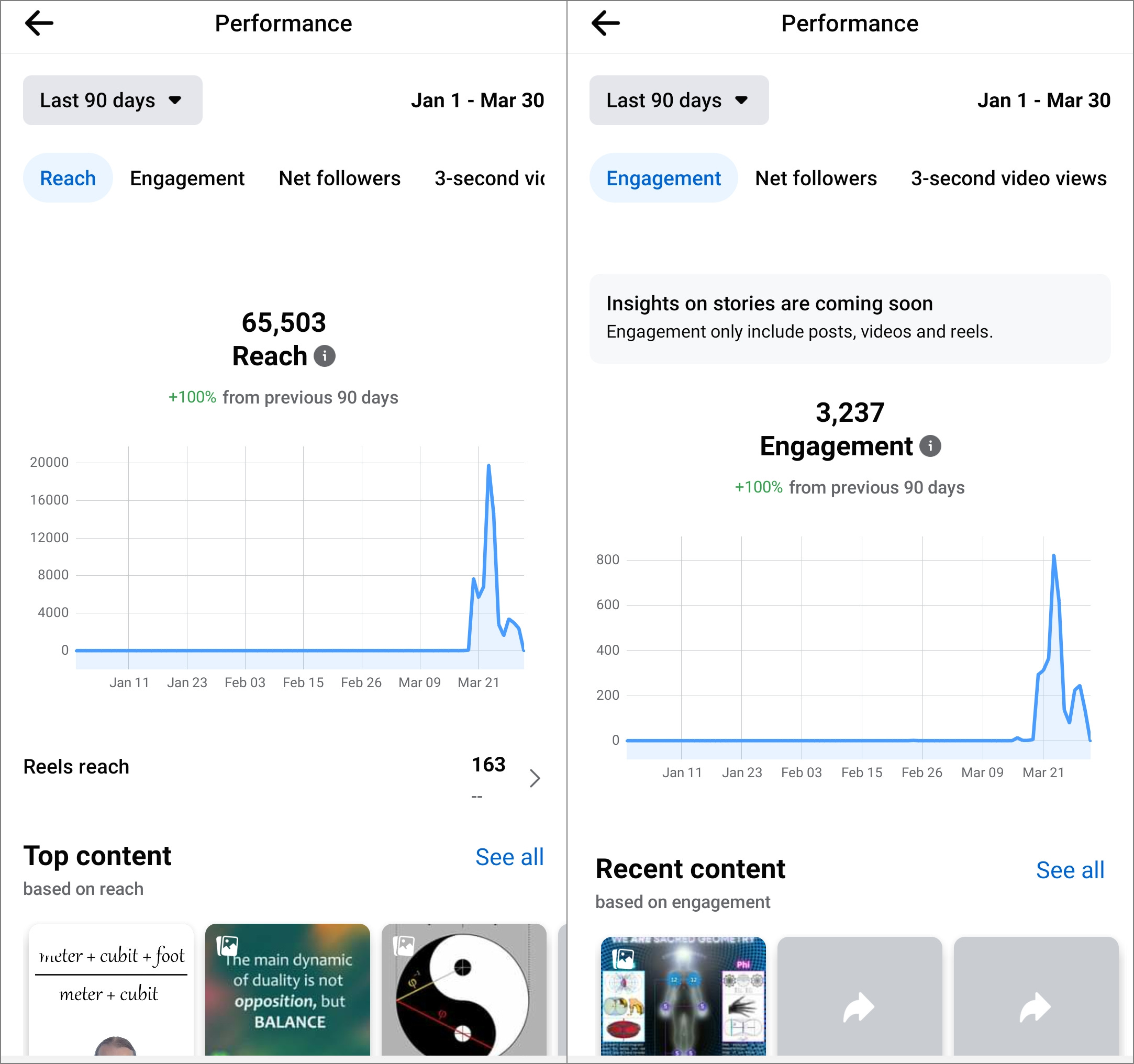
A good portion of these figures can be attributed to the fact that Facebook enables those with a professional page to directly invite anyone who reacts the page’s group posts to follow the page, which is exactly what I was doing here—hundreds of times. Between thirty and forty people did end up liking and/or following my page during that late-March time frame, but the question is, how many people actually clicked on my video as a result?
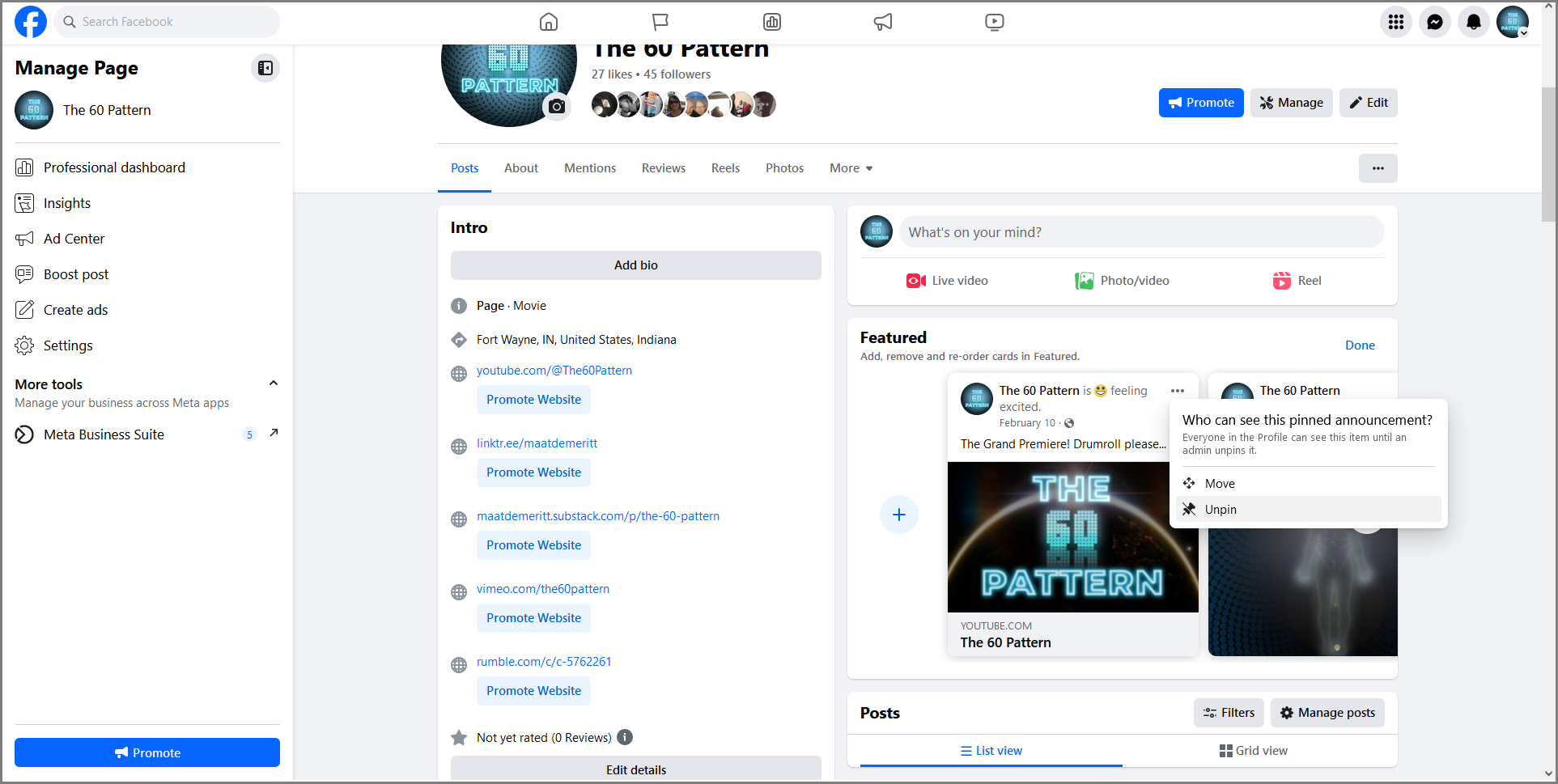
Before we get to the YouTube data, it’s crucial to establish what users saw if they visited my page. At the top of the page, just below the banner, profile picture, followers, and menu bar, is a section titled “Intro” (it’s called “Details” on the mobile version of Facebook), where users would see that the page’s main identifying label is “Movie.” Below that, there are links listed, the first of which is my YouTube channel. They would also see, right next to this (or just below it on mobile), a “Featured” section that had a direct link that they could click on to immediately start watching The 60 Pattern. Clear. Easy. Convenient.
So between the tens of thousands of people who saw my content, the thousands of people who engaged with it, and the nearly seven hundred people who reacted positively to it and were personally invited to my page, wouldn’t it be reasonable to suspect that at least one of those people would have actually clicked on the video to begin watching it? You would think. According to YouTube, however, NO ONE DID.
As we dive into the YouTube data here, let me set the stage by first pointing out a few caveats and contextual matters. Recall that the peak of reach and engagement for my page occurred between March 22nd and March 25th, which was from a Friday to a Monday. Crucially, sandwiched within that time frame was the weekend, which would have given people more time and peace of mind to watch my video. For YouTube, it is reported that viewers need only watch a video for :30 seconds for YouTube to count it as a view. As far as how long it takes for YouTube to update the view counter to reflect a new view, it is widely reported to be subsequent to a 24 to 48 hour verification process, although as this source points out, YouTube has not officially published the exact time frame. So referring back to the Facebook data, even though the reach and engagement begins to spike on or about March 19th, I would like to start our consideration from its absolute peak value that occurred on or about March 23rd. From there, it would be reasonable to expect some movement on the 24th or 25th, given the aforementioned 24–48 hour verification process. By the 26th, it would seem even more than reasonable to expect something—anything—from an otherwise successful social media blitz whose sole purpose was to get eyes and ears on my video. As you can see below, however, my view count was utterly frozen during that entire time period plus two days afterwards—until the 28th!
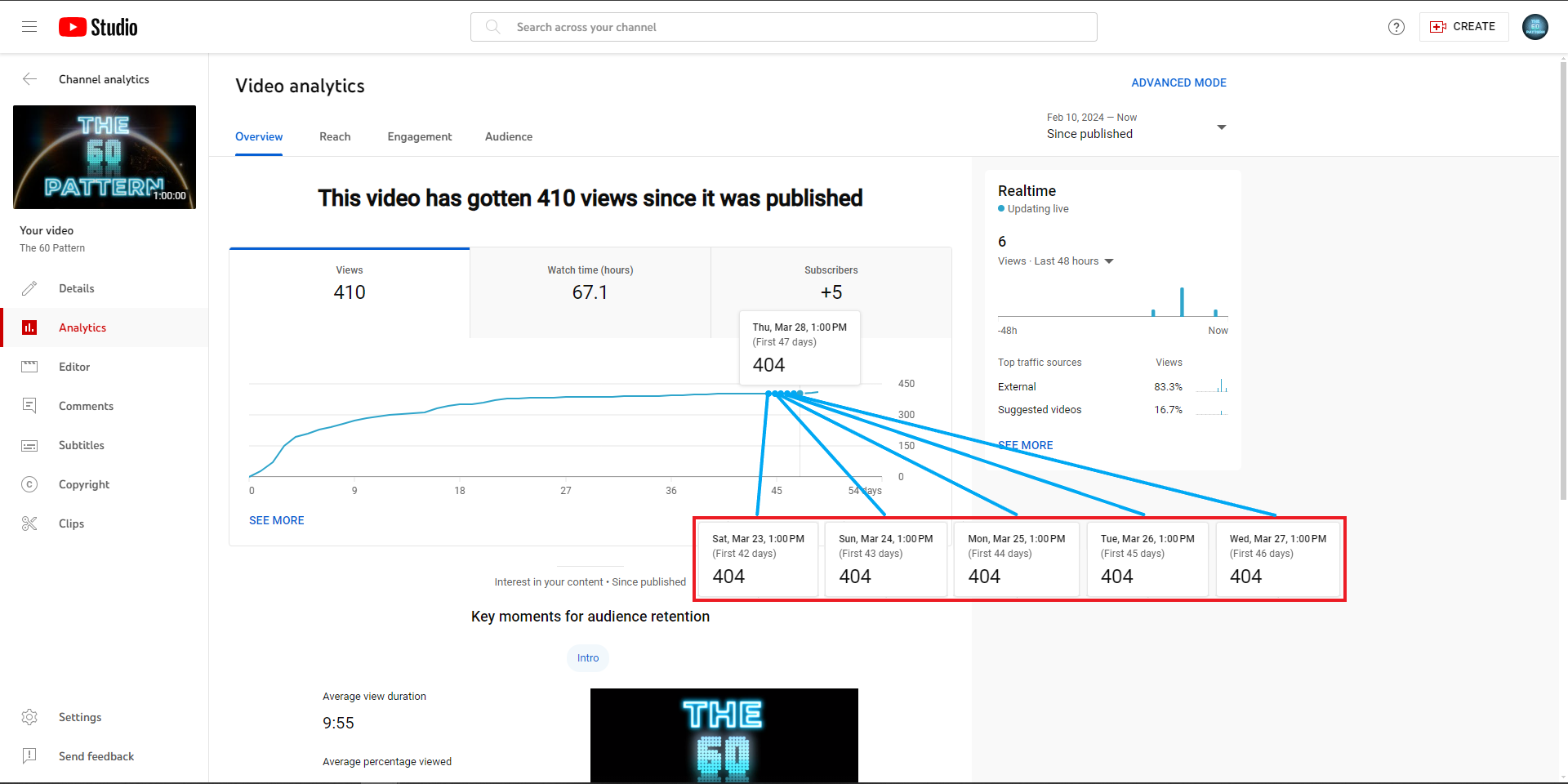
In total, my view count was frozen for seven days (the 404 view count starts on March 22nd), which was unprecedented. Prior to that, the longest stretch without a change in view count was three days, but that was a rare exception to what was ordinarily a daily uptick. Seven days—at a time I would have most expected at least a slightly elevated uptick. You can almost read YouTube’s algorithm, which is designed much like a musical compressor. Here it is “squashing a peak,” but it is doing so much too aggressively, leaving its signature and resulting in an unnaturally and inauthentically smooth line graph.
Assuming then that YouTube is suppressing my view count, we still have the open questions of:
what are they hoping to achieve, and
what is their motive in the first place?
As for the first question, I can point to the unfortunate tendency of people to judge something’s worth by its apparent popularity. This “popular = good” heuristic is especially a product of our digital age, when we are inundated with information and ever more hard-pressed for time. It’s forgivable in a sense, and there are certain contexts where it can be far more appropriate than others, but more and more I see evidence supporting the adoption of a counter-heuristic: “popular=bad.” However, nuance should rule the day here, not absolutism, and I would rather put it like this: in our day and age of brutal algorithms of an ever more controlled information ecosphere, popularity can be seen as a red flag or at least a sign of a “sanitized” or compliant/non-dissenting voice. Until this counter-heuristic gains deeper roots in people’s consciousness, rest assured that the firmly rooted “popular=good” heuristic will continue to be taken advantage of by those with the means and the motive to suppress dissident voices with truthful messages that are inconvenient or damaging to the status quo.
Dissecting the Motive
While I am going to be speaking specifically about YouTube here, I want to stress that a lot of what follows generally applies to all of the social media juggernauts, along with their ever more concentrated group of controlling overlords who want an iron-fisted grip on the information ecosphere. So I touched on motive in the last paragraph by referring to dissident voices, of which I would certainly count myself. That is one of two aspects to the motive that I will discuss here—the one that is somewhat more personal. By that I mean it likely specifically has to do with my individual, personal content—certainly not for that specific YouTube channel, and almost certainly not limited to my Google account as a whole. Rather, it’s more than likely that the underlying basis for the much anticipated, feared, and reviled “social credit score” apparatus—a conglomeration of one’s personal data scraped and collected both publicly and privately, legally and illegally, and used to covertly reward or punish individuals—is already well underway and in effect. My current theory is that the colossal data centers that are going up everywhere are going to play a key role in this. The cover story is that these gargantuan constructions are being used for bigger and better AI, but it is well known and has been for quite some by industry experts (see, for instance, here) that the theory that scaling compute leads to better AI is dubious at best.
Before moving on to the second aspect of the motive, which contrastingly has much less of a personal dimension, I want to further clarify the personal dimension of the first motive. That is, it’s extremely one-sided. In other words, while there is a person on one side being affected, there is no person nor people on the other side being directly motivated in the moment—everything now is primarily automated by algorithms and, increasingly, AI. By design, corporations have grown to be ever more robotic, squeezing out every last drop of human empathy and compassion. They are greed machines (yet ironically, corporations are considered a “person” according to the infamous Citizens United ruling of the US Supreme Court). Anyway, I point all this out because there’s a sort of weaponized stereotype of a “conspiracy theorist” who arrogantly and delusionally assumes that he or she is important enough to receive personal attention and condemnation from “them,” and I don’t want to be accused of having that mentality or perspective.
Speaking of “conspiracy theories,” what likely triggered the suppression algorithms in a big way for me was my elaborate takedown of probably the most consistent and prolific establishment media narrative of the twenty-first century—in a nutshell, the narrative that “conspiracy theory = bad.” Indeed, it is often ridiculously presented as such an absolutism, despite the nuanced, logical, and common sense view that would state otherwise. A couple years ago, I published a 7-part, nearly 4-hour deep dive into this aggressively force-fed mainstream narrative on my show “Mind Blown”—published on YouTube and elsewhere—thoroughly dissecting and dismantling it. No one needed to personally watch the video to trigger the supposed algorithmic suppression—YouTube automatically analyzes uploaded videos and produces a written transcript that can be fed into the algorithms.
The second aspect of the motive is impersonal, having generally to do with controlling the information ecosphere. Very noticeably for YouTube and other platforms like Instagram, smaller, newer channels and accounts are automatically suppressed. For YouTube specifically, a Redditor with the handle K0KSAL (whose account was mysteriously suspended by Reddit, I just noticed) wrote an excellent post about this phenomenon. The Redditor points to a “2018 algorithm tweak” that “basically ‘shadow banned’ small channels.” 2018 was right in between the contentious 2016 election and the onset of COVID in late 2019, when banning, censorship, and general hysteria were on an exponential rise, so the timing is fitting. The Redditor goes on to explain that YouTube basically operates like a two-tiered system. Either you’re “in” or you’re “out,” and those who are “in” are part of what this Redditor calls the “suggestions ecosystem:”
All the prominent YouTubers don’t need to aggressively promote themselves outside YouTube, because their videos derive a vast majority of the traffic from appearing in the “recommended” bar on the right side of other videos. Entering this ecosystem is your main supply of views.
Check the sources of your current traffic: according to YT associates, a healthy channel should have around 70% of its traffic from “suggestions,” not through “search” or “external sources,” but by appearing on the right next to other similar videos in the recommended section. If you’re getting 1–2% of views from “suggestions,” it means YouTube has filtered you out of their ecosystem—no matter how relevant your video title, description, or tags are, if your videos can't derive traffic from being suggested, your channel will stagnate.
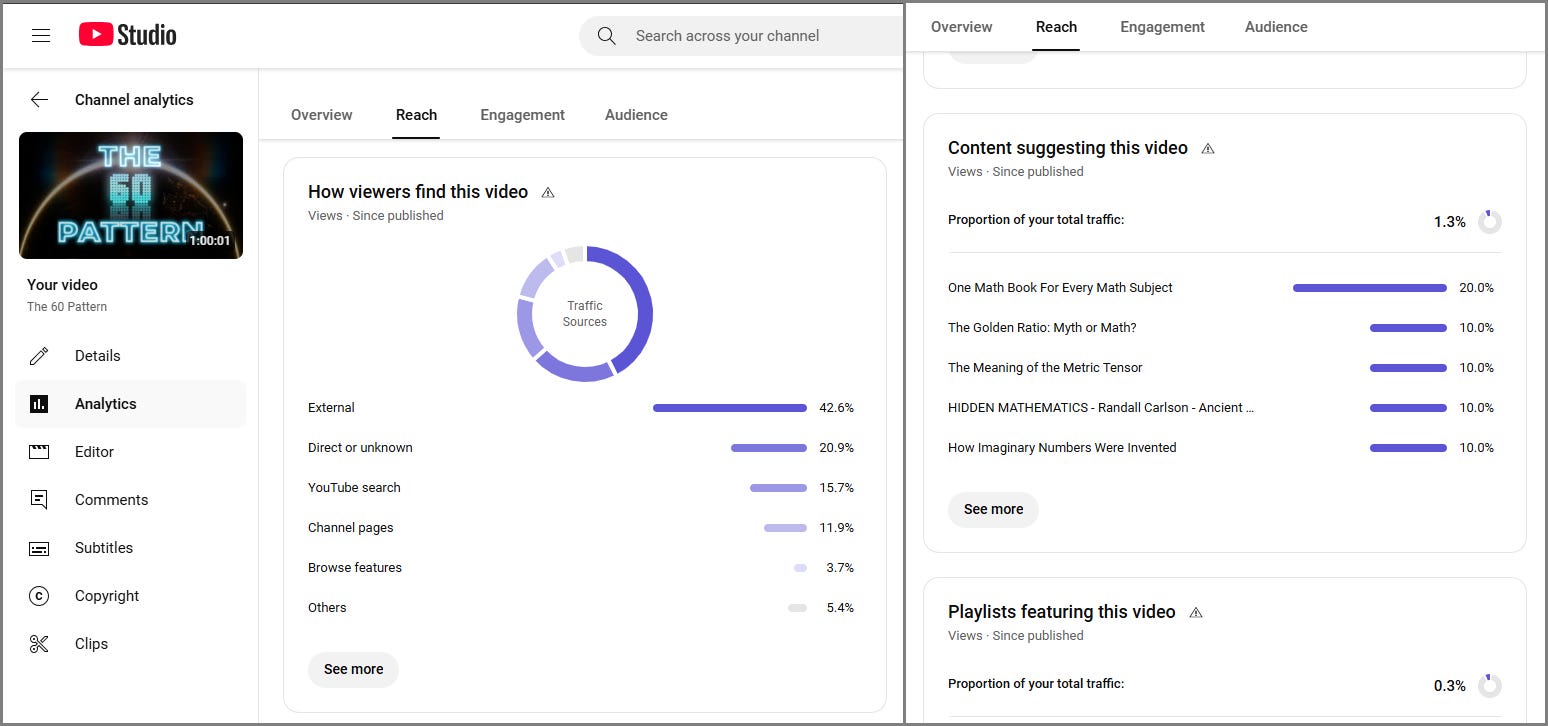
This person is describing my channel exactly, which gets such a small percentage of views from “suggestions” that it’s buried under “others” in my reach analytics. Upon further scrolling, I find that my percentage of views from suggestions is a dismal 1.3%—a far cry from the 70% needed for a “healthy channel.” Clearly I’m not part of the “in” crowd.
Let me make a few additional notes on this second aspect of the motive. We should all well know by now what extreme and horrible lengths certain groups of individuals will go to in order to control the powerful and influential members of society, and we know how such nefarious agendas can and have blown up—causing problems told and untold. If it isn’t obvious, I’m referring to the despicable honeypot operation involving Jeffrey Epstein that the current US president was very possibly ensnared in. This is just the tip of the iceberg with regard to the control and manipulation that goes on behind the scenes. The long-standing, loose coalition of establishment figures—often tied through bloodlines, but also through their mutual, almost inhuman, greed, lust, thirst for power, and sheer lack of empathy—operate much like a legally sanctioned mob. Some refer to “them” as the “cartel,” but there is no “they” per se. Again, it appears to be a fairly loose coalition of people who are united only by shared interests and a shared lack of morality—people who probably stab each other in the back as much as they cooperate.
However, recent developments within the last decade, such as the bioengineered COVID-19 epidemic and the CARES act, vastly accelerated the already extreme and exponentially rising wealth inequality. Now, more than ever, we see what appears to be a united front, whereby corporations will even act against their own apparent self-interest in order to serve a larger agenda. This is unprecedented; the market is losing its “ultimate say,” and we are truly witnessing the deliberate, accelerating transition from capitalism to tyrannical oligarchy—right before our eyes.
A primary result of this vast consolidation of wealth and power is the agenda to maintain or accelerate this trend, and a primary means of doing so—bringing us right back on point—is to control the information ecosphere. Algorithmically suppressing all novel voices (minus the specially curated ones) is an effective means of preventing “wild cards” or revolutionary new voices from taking root, while previously established voices—ever whittling down—are more so controlled and manipulated via traditional means like blackmail, lawfare, covert infiltration, and so on. Again, we see the tell-tale united front in this regard, whereby it isn’t just YouTube, but nearly all of social media that practices such blanket suppression.
No More Hashtags, No More Discoverability, No More “If You Build It, They Will Come”
For authentic voices of truth, especially if they are new, brutal algorithms rule the day. However, if one’s content is primarily “sanitized” or arguably distracting with respect to critical truths we are in dire need of facing, this generally does not apply. For others whose content is much more directly in line with certain establishment agendas, a reverse algorithm exists that boosts their content and pages/accounts tremendously. Fitting into the latter category is those whose content is extremely polarizing and divisive, which is an important point that we will return to later.
From my experience, certain long-standing staples of social media and the internet age are all but defunct. Hashtags do next to nothing to sway the algorithm and lead to more discoverability. Meta platforms, especially Instagram, seem especially egregious in this regard. Somewhat humorously, but also in an effort to highlight this important, disturbing truth, I tagged a few of my posts with the likes of: “HashtagsDontDoJackShitAnymore, #WhyEvenBotherTagging, #EvilAlgorithms, and "#AlgorithmicControl.
The old adage of “If you build it, they will come” is far from a given anymore. It doesn’t matter if the work is groundbreaking, in-depth, original content. It doesn’t matter if it was developed with passion and academic rigor, over the course of decades of comprehensive research and the establishment of foundational epistemological moorings. It doesn’t matter if the work affects our understanding of ourselves in profound and novel ways, yet still strives to attain high aesthetic and entertainment values. It doesn’t matter if the work has revolutionary unifying potential, with strong implications for peace and prosperity. And furthermore, it doesn’t matter if the work has an explicit and steadfast commitment to the truth. Actually, those last points do matter, but rather in the sense of the making of the opposite expression: if you build it, they will never even know it exists.
Social (Credit) Media
YouTube, Facebook, Instagram, and X all operate relatively plainly as tiered caste systems, where money and message—primarily the latter—determine your caste or social credit ranking. Part and parcel to this are all of the previously described phenomena: brick-wall algorithms, useless hashtags, and the apparent shadowbanning and suppression of smaller accounts. While these platforms vary considerably in a number of ways, this consistency is quite pronounced and noticable, calling to mind the “united front” mentioned earlier as a result of profound wealth and power consolidation. I would not be surprised if singular database already exists that all of these platforms are using—not necessarily for entire populations, but at the very least for individuals who have been “flagged” for whatever reasons are contrary or inconvenient to establishment agendas.
What about the alternatives? Mastodon, being a decentralized social media platform, seems like it would be a viable alternative. However, after two years of using it, even despite encouraging all of my connections everywhere else to expand their social media footprints into such alternatives, as well prominently placing my Linktree account (a single webpage that links to all of your online pages and accounts) on all of my profiles and many of my posts and videos, I still have only accrued one follower on that platform. It simply feels like a ghost town there, and I believe it has to do with some of its features that I find to be quite awkward. It’s a similar story with Telegram. After years of linking my work to my Telegram channel, I only have one subscriber (it actually shows two, but by default, you are “subscribed” to your own channel). As a result, I barely even bother to post to these accounts anymore.
Rumble
For the video-hosting platform Rumble, which is often touted as a “free speech” alternative, my content is even more suppressed than on YouTube, if you can believe that. I am actually completely blacklisted from search results on Rumble. I have two channels on there linked to my account—one called The 60 Pattern, and one under my name, Maat DeMeritt, that I use for publishing music. Here are the completely empty search results for those exact titles under “Channels:”
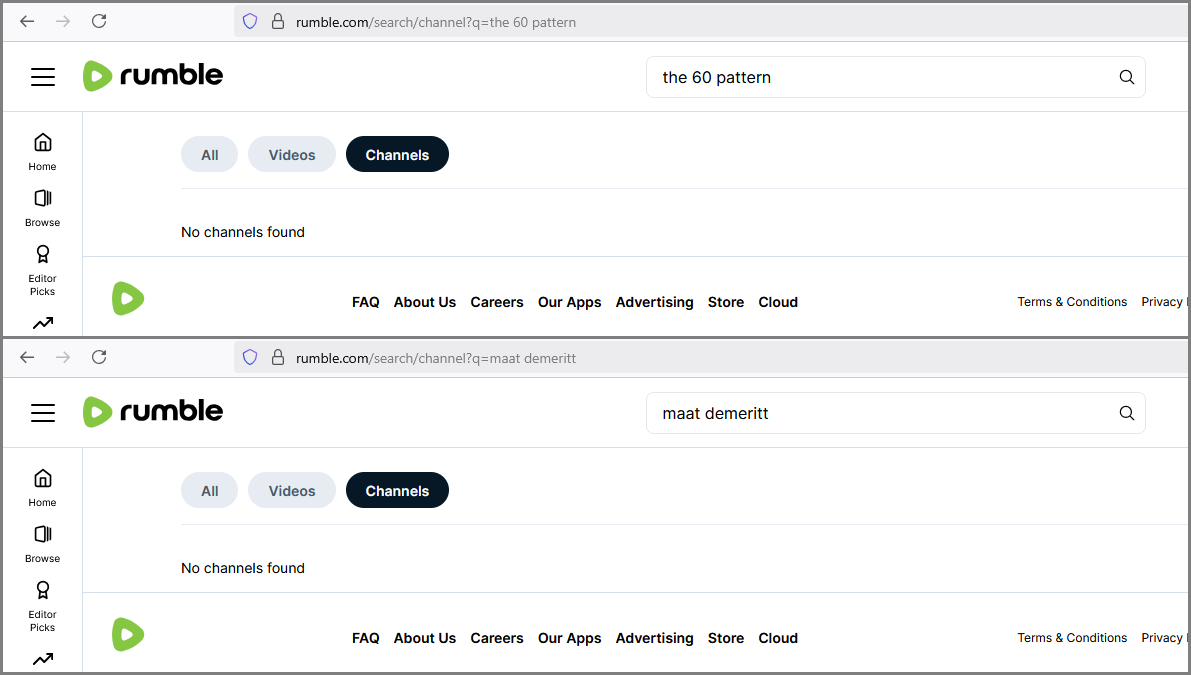
Note that none of my videos show up under the “All” or “Videos” categories either, or at least after searching through several pages of wildly irrelevant results. All of this is really no surprise though, considering that billionaire globalist and Bilderberg Steering Committee member Peter Thiel, who founded and chairs Palantir, was a key investor in Rumble in 2021.
Free speech is not a partisan idea—and never should it be—yet it has been attempted to be made into one via perhaps the most long-standing establishment agenda—divide and rule. I was initially attracted to Rumble because of its supposed “free speech” ideal, not because of its strong ties to conservativism and “conservative figures” via both platform-wide content, investments by the likes of vice president JD Vance, and agreements with president Trump’s TMTG (Trump Media & Technology Group;) (when it comes to most establishment figures, partisanship is probably largely a facade, with their true motivators being greed and lust for power). I typically do not sign up for accounts on such partisan platforms as this, which also include Gab, Truth Social, and Bluesky, as my most primary and foundational message is inherently contrary to partisanship in general. In fact, were my simple message of balance and egoic unidentification (as I discuss in articles here and here) to be widely understood by the masses, it would be like kryptonite to this establishment agenda of divide and rule, as well as the establishment itself. I believe that there are those in the establishment, (who, by the way, essentially control agencies like the CIA that have a long history of psychological warfare operations), that understand this as well, and I’m starting to suspect that it this particular aspect of my work contributes significantly to me being flagged an “undesirable” by their algorithms.
TikTok
As far as TikTok is concerned, while I do have a few videos on there, I have to say right upfront that I do not like using the platform. Its manner of immediately slapping short, attention-span-killing videos into your face upon opening the app I find to be extremely aggressive and annoying. My instinct is to immediately turn off the app after I launched it, as it has the feel of a virus taking over my phone (and this is also their “Home” screen on their UI, so there is really no place to go to feel “grounded” on their app). As far as suppression goes, while I was initially very pleased with my effortless reach on TikTok, a recently published video demonstrates that a “switch” has essentially been flipped, leading me to become shadowbanned. Look at the view counts of my three videos to date, with the third having been published 11 days ago already:
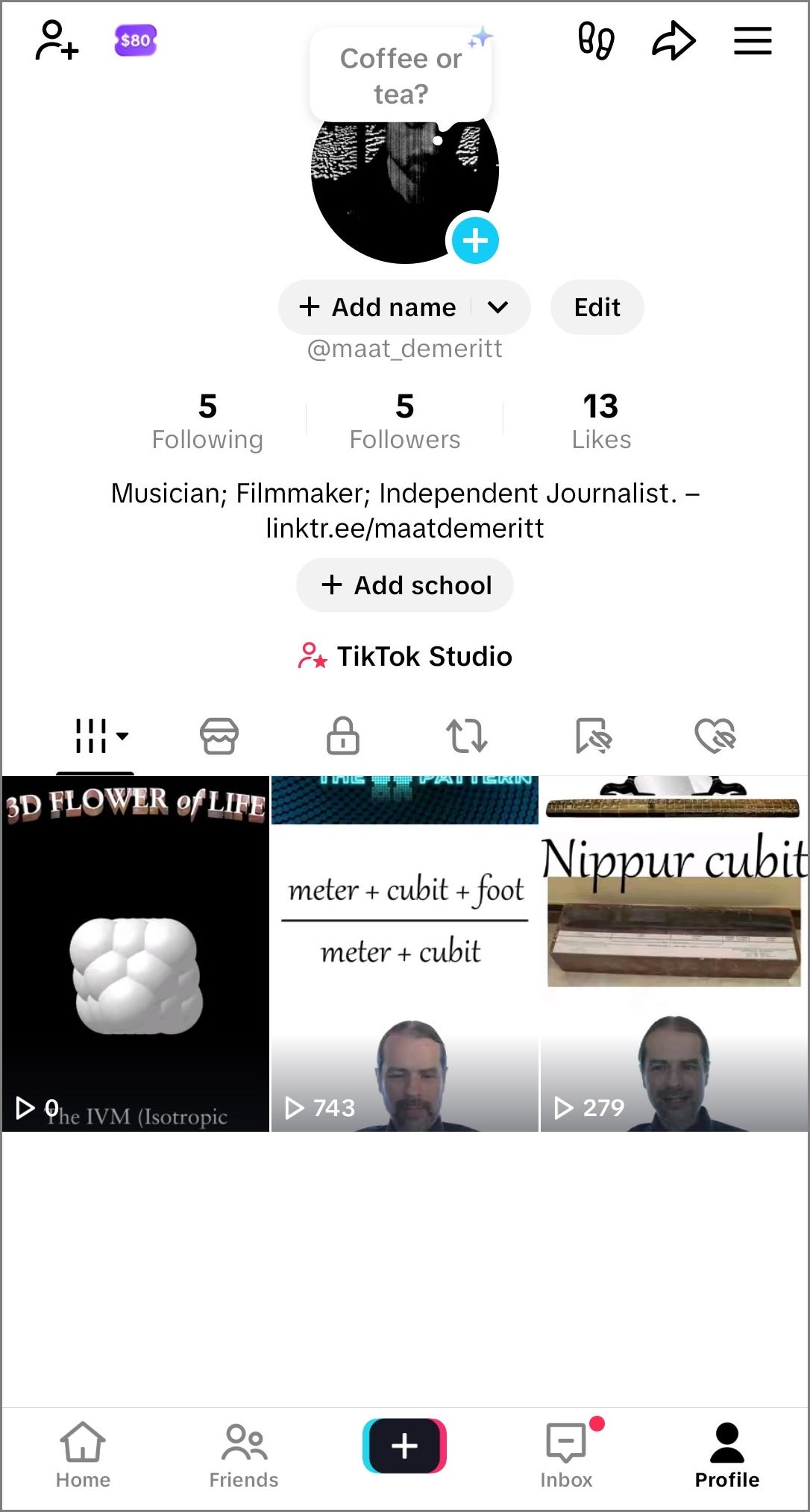
This is quite revealing with respect to the fact that my first two videos, published in March of 2024, occurred before TikTok was temporarily banned in the US via congressional legislation, and subsequently restored via assurances made by Donald Trump. While on the surface, the reason for the ban was given as “Chinese spying” and feigned concern over children becoming addicted to the app, many suspected that the real reason was that millions of people, especially of the younger generations, were receiving news and firsthand accounts of the Gaza genocide via TikTok and thus becoming vehemently opposed to the Israeli government and their wanton slaughter of innocent civilians. Note that AIPAC, the American Israel Public Affairs Committee (which, by the way, has never been registered as a foreign agent as it must under FARA, the Foreign Agents Registration Act), currently bribes just over 75% of congressional representatives, and 97 out of 100 Senators. These numbers weren’t much different in the prior, 118th congress, and AIPAC lobbying was probably largely to blame for the TikTok ban getting passed. Just last month, TikTok appointed Erica Mindel, a former Israeli solder and US State Department contractor, as its “Public Policy Manager” overseeing “hate speech.”
While my videos on TikTok have nothing to do with Israel or Palestine, my activities on X make it abundantly clear that, like any normal human being with morals and compassion whose head is even slightly above the choking fog of US-Israeli propaganda that inundates our information ecosphere, I am expressly and explicitly opposed to the Israeli regime’s ongoing genocide and long-standing occupation of the Palestinians. But does this have anything to do with the absolutely precipitous drop-off of my view counts on TikTok? Given what we have discussed so far, it certainly seems par for the course.
Facebook
Facebook, who is also largely beholden to Israel, seems to be crawling with nefarious agendas, and not just limited to shadowbanning and suppression. My experiences pale in comparison to what Jeff Kurtz of the amazing Human Reform Politics page (which is highly sympathetic to the Palestinian cause) went through, as detailed in the following infographic:
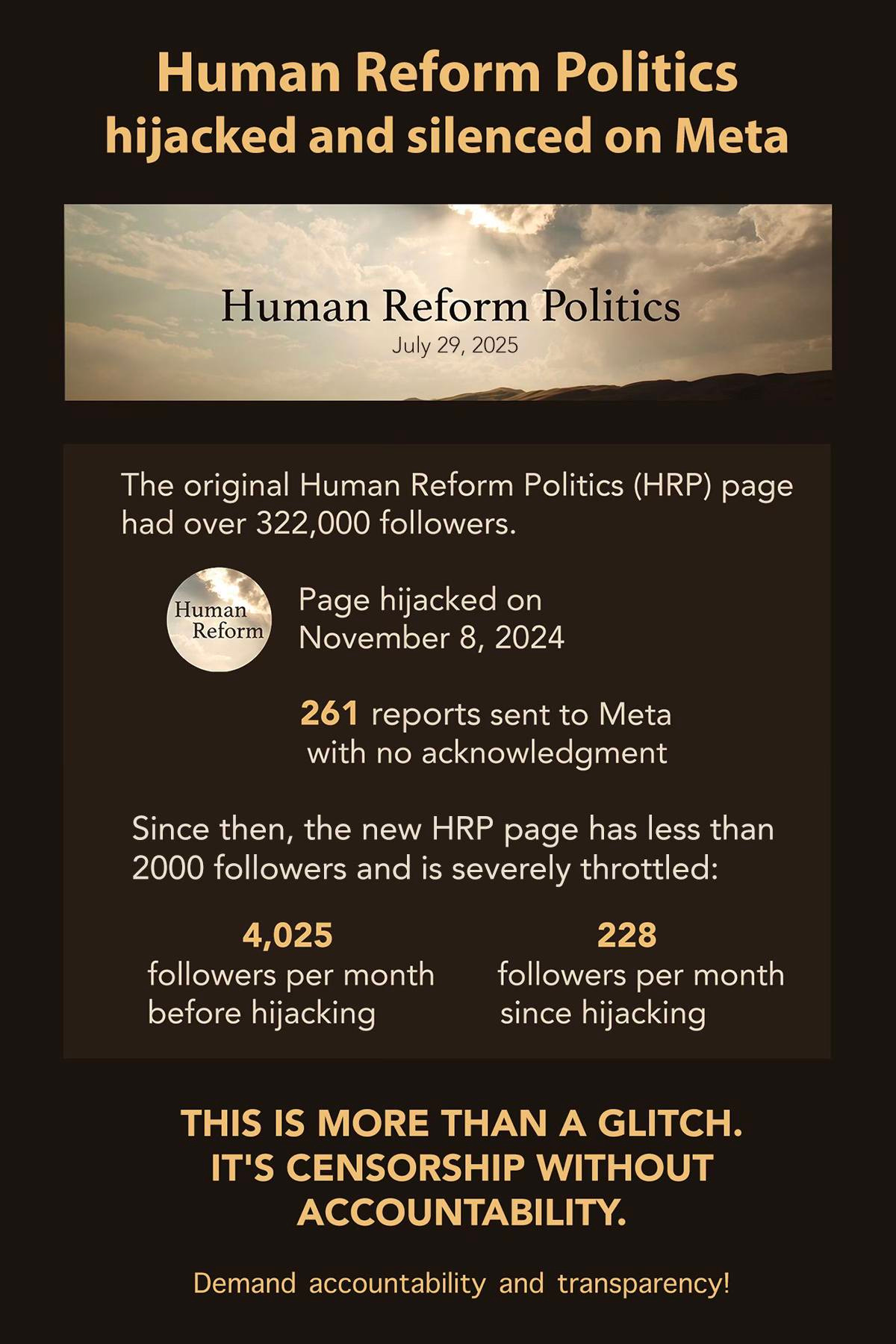
The hacked account, which changed its name to “Mr. Story,” began to aggressively post clickbait articles in an apparent attempt to tarnish HRP’s reputation. I called this out in the comments of their posts nearly every chance I got, and as a result of one of those instances, Facebook actually suspended and unpublished my page. While it ultimately claimed after review that “our technology made a mistake,” it’s difficult to see it as anything other than a deliberate shot across the bow in response to my pointed criticism of their platform. See my saved screenshots of the short saga below:
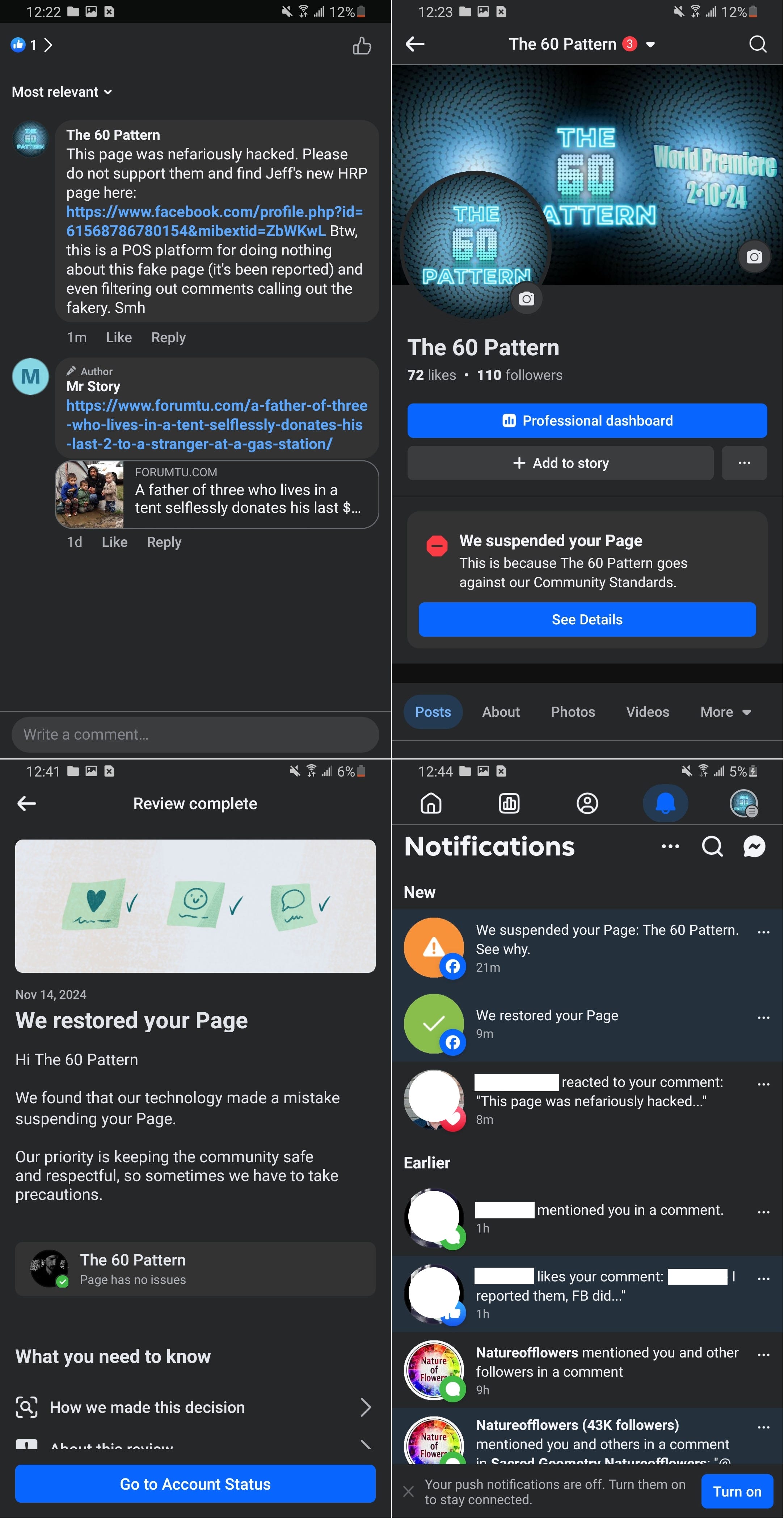
As I pointed out in my comment, Facebook was filtering out comments like mine—labeling them “potential spam.” As for calling Facebook a POS (piece of shit) platform, I not only stand by that statement, but I reiterate it here. Even though I ultimately obtain the most exposure for my work through Facebook, what little I do get is a dismal pittance in the context of how much painstaking effort it takes to it carve it out from Facebook’s 3 billion active daily users. I frequently see how my posts are comparatively suppressed with respect to similar content that was posted at the same time, and it’s also just a constant struggle against gatekeepers and/or Facebook’s underhanded suppression tactics (it’s often impossible to know the difference). This includes labeling posts and comments as “potential spam” without ever acknowledging that they are doing so—actions which lead to comments getting filtered out and posts getting automatically “declined” (read: censored) from groups’ using Facebook’s AI-powered “Admin Assist” tools.
All the while, plagiarizing, content-churning bot accounts, charlatans posting AI-slop, and even Meta’s own AI-generated “users” are allowed to run rampant—sucking the air out of the room. Connor Hayes, Meta’s vice president of product for generative AI, stated in an interview with London’s Financial Times that “We expect these AIs to actually exist on our platforms in the same way that [human] accounts do.” As I have explained elsewhere, AI content is flooding the information ecosphere and drowning out authentic voices—artists, philosophers, researchers, peace activists—real people with real families, real information, real ambitions, and real dreams. I stress that all of this falls in line with the aforementioned agenda of controlling the information ecosystem, whether this was the original intent or not. And there’s no competing with it—a single post with an infographic and textual element often takes me 1–2 solid working days to complete, while AI can create its crude forgeries in mere seconds. It can run circles around us, and all of this is just going to get worse and worse.
Reddit
While there are many more acts of suppression and dubious shenanigans on Facebook that I can evidence—more than enough to create its own dedicated article—I would like to make a few notes about Reddit before wrapping things up here. First and foremost, I have to say that I find Reddit to be truly loathsome. This has little to nothing to do with the platform itself, like how it’s structured, its user interface, and its functionality (although I must admit that I do find their red-eyed robot mascot to be somewhat creepy). Rather, it has everything to do with the intolerable amount of viscous, rabid trolls that fester there (and at least one case of Reddit enabling such behavior, as will be discussed). It must be the default anonymity that bolsters their keyboard-warrior “courage,” but in any regard, the platform is quite toxic, even on subreddits like r/SacredGeometry and r/spirituality that I frequent and that you would think would be relatively safe.
With regard to suppression, I would first argue that the toxic environment itself leads to self-suppression. I certainly limit my time there, and typically cringe and grit my teeth before I post. There was one particular incident when someone doxxed me—revealing my name—which is in clear violation of Reddit’s rules. The Redditor was having a rather contentious disagreement with me about my post, and eventually grew quite angry and vindictive at the end of the interaction—spewing ad hominems, profanity, and ultimately doxxing me. While I proudly put my name to my work, and generally find the anonymity of Reddit to be more of a hindrance than anything, I was still quite taken aback by the incident. The main point I want to make here, however, is that not only did the r/SacredGeometry moderators do nothing in response to my flagging of the toxic, out-of-line behavior, but neither did Reddit itself after I reported the incident through their official channels. As evidenced by the link I just shared, the Redditor’s offending comment is still up (note that accounts showing “deleted” were deleted by the Redditor, whereas banned accounts retain their original username). The takeaway is that Reddit can be shown, with at least one case to back it up, to be enablers of the toxic behavior that plagues their site.
In another incident, I submitted the following post to the subreddit r/peace, only to have it removed on the basis that it was “not obviously related to peace.” This is despite, as I state in the above-linked post (which had to be posted to my own profile), “the actual opening line of the post specifically mentioning the achievement of peace and prosperity as the main goal.” Their justification was thus clearly bullshit, leaving us only to speculate as to the real reason for its removal.
I have poured my heart and soul into my work over the last several years, while taking great risks and undergoing debilitating financial strain. It is not fame I seek, but just the opportunity to live and grow by simply exercising my natural talents and doing what I believe is my purpose in life. But I feel I am being smothered here.
In the last five years, entirely by myself, I have written, recorded, mixed, and mastered full-blown rock songs and other musical productions, several with accompanying music videos; I have launched my own show, Mind Blown, handling all aspects from research and writing to filming and editing; I have similarly produced a full-blown documentary film, which also involved the creation hundreds of graphic design elements, the scoring of original music, and a social media marketing campaign, and I have written and self-published a 200-plus page illustrated book. All the while, I have been growing my Substack account with many in-depth articles, and I have designed dozens of memes, short videos, and detailed infographics with lengthy accompanying posts for social media. But it’s far more than just the labor involved—it’s the meaning and import of the work. On its combined basis, I firmly believe that the foundation exists for a revolutionary unifying movement—one that could profoundly shift consciousness and help lead society to unprecedented levels of peace and prosperity. This is ultimately the direction I am headed; I am not backing down.
You might think, after all this time and considering all of the above, that it might have led to some amount of recognition or support—some small toehold of an opportunity to advance and grow my work. Yet due to the overwhelming suppression, which also involves harsh and deliberately engineered economic suppression that is blanketing our society—myself and many others—artists, activists, philosophers, psychonauts, spiritualists, and dissidents alike—are all wallowing in obscurity. While I do take this very personally, this isn’t about me. Not only is my work conceived of in service to others, but we are all—from the general working class to hardened dissidents—facing this blanket suppression. The powered establishment has vastly swept up control of the town square—our means of public discourse—and they have long sought to control our minds through focused psyops, propaganda, and general psychological warfare. Not stopping there, they now want control of our bodies, and have made drastic and unforgivable steps of invading this—one of our most cherished and sacred spaces. They have also swept up vast and ever increasing control of our livelihoods and potential via nefarious financial and economic means. Meanwhile, this veritable sociopathic death cult is force-feeding us media content that is trivial, distracting, divisive, propagandistic, and often utterly fake AI-slop.
So what can we do? Where can we go to get a level playing field and wrest back control over our very own lives and that of our children and those to come? I am certainly open for ideas and suggestions. I will say, for what it’s worth, that Substack is one of the only platforms that I like and trust. Unfortunately, as a publishing platform it is significantly different from a general social media platform, but perhaps that could change. Right now, there is a gaping void where a balanced, highly functional, non-suppressive social media platform—a new town square—should exist. It’s a far cry from my means and realm of expertise to make that happen, but calling attention to its dire need is still doing a small part, and I ask for your help in that and in any other way that you are capable of. We also need to support each other—support small online accounts, small businesses, local artists in our communities, and truth-tellers and dissidents everywhere. Counterbalance the idea or heuristic that “popular=good” with the awareness that, in this day and age of iron-fisted algorithmic manipulation and suppression, popular often equals “bad.” However, it’s always been best to just judge things based on their individual merits. Use discernment, balance open-mindedness with skepticism, balance hope with realistic expectations, and be ever vigilant my friends. Godspeed. The work continues…